

The stories we tell shape us. The stories we choose to remember communicate our values, helping us recognize both who we have been and who we are becoming.
Over the past few years, Rev. Luana Cook Scott, pastor of Morristown UMC, and her congregation have been exploring the power of storytelling through Pathways Bridges. They have deeply engaged the practice of listening to their community, which has transformed their understanding of themselves and planted seeds for new relationships to grow.
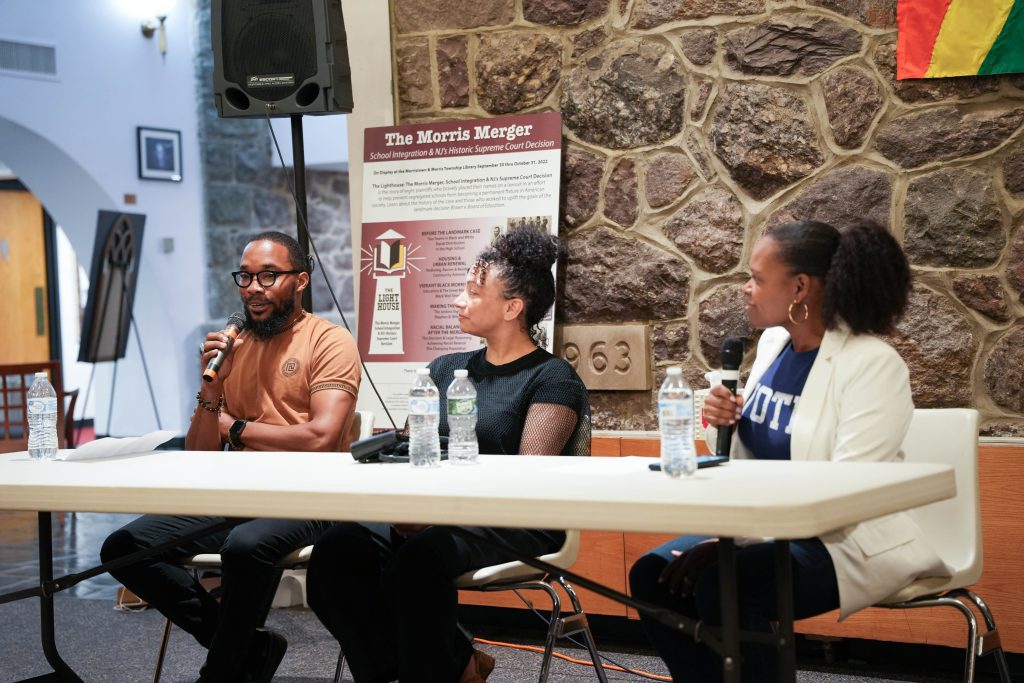
When Candace Kelley, a member of Morristown’s ARISE community, a group focused on social justice and belonging, approached Rev. Cook Scott with a proposal to bring the traveling installation, The Lighthouse: The Morris Merger, Integration, and New Jersey’s Historic Supreme Court Decision, to Morristown UMC, Rev. Cook Scott did not hesitate. She immediately agreed to host the exhibit at the church.
“This is not just history, it is our history,” said Rev. Luana Cook Scott. “A Journey of Hope calls us to listen, learn, repent, and transform. These events are part of how we live out that calling together.”
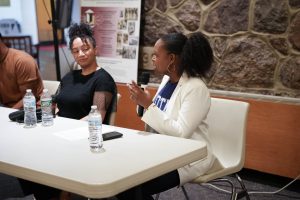 On May 29, 2026, The Lighthouse: The Morris Merger, Integration, and New Jersey’s Historic Supreme Court Decision celebrated its grand opening with a panel discussion, though the exhibition itself was less grand than planned.
The panels, which had been stored at Morristown High School, had been damaged. Corners were broken off, and sections had pulled apart. Ironically, the exhibit was damaged in the very location whose story it sought to tell. There is something within us that resists looking too closely at the painful parts of our past.
The exhibit detailed the story of the Morris merger, the court cases that paved the way, the parents who fought for equal access to education for their children, and the overcrowded high school that ultimately pushed Morristown and Morris Township to fully integrate into one school district.
The Backstory
Some court cases are familiar to nearly everyone who has taken a high school history class. Plessy v. Ferguson established the doctrine of “separate but equal” in 1896, while Brown v. Board of Education overturned that principle in 1954 by ruling that segregated schools are inherently unequal.
Others, however, are far less well known. One such case is Hedgepeth-Williams v. Trenton Board of Education (1944). This New Jersey Supreme Court decision created the only state-level school anti-segregation precedent in the nation and was later cited during litigation in the U.S. Supreme Court’s Brown v. Board of Education case.
These decisions laid the legal groundwork for Jenkins et al. v. Morris School District and Board of Education (1971), the lawsuit that would ultimately desegregate the school districts of Morristown and Morris Township.
Segregated Neighborhoods Create Segregated Schools
In addition to tracing the legal precedents that paved the way for integration in Morristown, the exhibit explained the economic systems that created and perpetuated segregation. School segregation does not happen by accident; it develops when African Americans face barriers to homeownership and wealth-building.
The exhibit showed how African American residents in Morristown became concentrated in the town’s Second Ward. Federal housing policies allowed racial exclusions to be written into property deeds, preventing African American families from purchasing homes in many neighborhoods. The practice of redlining, instituted in 1933 by the Federal Home Owners’ Loan Corporation, produced Residential Security Maps that made it nearly impossible for African American families to obtain federally backed home loans.
Several African American families in Morristown, including the Kersey, Pinkman, and Watson families, built their homes themselves after being denied access to government programs and financing.
The legacy of these systems could be seen in the disparity in home values. During the 1950s, the average home in Morristown cost between $22,000 and $24,000, while homes in Morris Township averaged between $40,000 and $60,000. African American residents, who had faced generations of barriers to homeownership and wealth accumulation, were more likely to purchase homes in Morristown than in Morris Township. Economic inequality reinforced racial segregation.
“In order to have integrated schools, you have to have integrated housing. It takes the total community to change anything,” proclaimed Dr. Felicia Jenkinson, wife of one of the original plaintiffs in the lawsuit.
For decades, students from Morristown and Morris Township attended the same high school. However, as enrollment increased and the school became overcrowded, the wealthier Morris Township began making plans to build its own high school and dissolve the long-standing sending-receiving relationship.
The move would have left Morristown High School with fewer tax dollars and a significantly higher percentage of students of color. Parents fought back. To separate, they argued, would be to remove resources from where they were most needed and deny all students the benefits of learning in a diverse educational environment.
Eight residents, later nicknamed the “Jenkins Eight,” sued the Township of Morris and its Board of Education. The case eventually reached the New Jersey Supreme Court, which ruled in 1971 that allowing Morris Township to create its own high school would result in “de facto” segregation.
Following the decision, the two districts merged into one, preserving integration at the high school level and creating integrated elementary and middle schools for the first time. At the time, the Jenkins decision was called a “Lighthouse” ruling. Those who fought for integration hoped it would illuminate a path for other districts to follow.
The work is not yet finished
Sadly, the Morris merger remains a beacon that few New Jersey school districts have chosen to follow.
A panel in the exhibit was dedicated to the work left to do. It detailed the efforts of the Latino Action Network and its partners, who filed a lawsuit against the State of New Jersey on May 17, 2018—the 64th anniversary of Brown v. Board of Education. The suit argues that persistent segregation by race and poverty in New Jersey’s public and charter schools violates the state constitution.
According to the lawsuit, New Jersey is one of the most diverse states in the nation, yet its schools rank among the most segregated for Black and Latino students. The lawsuit remains ongoing.
In addition to curating the installation, Kelley organized a panel discussion where community leaders could reflect on the history of integration and consider the work that remains.
She was joined by Cyndall Brice, Program Manager for Morris Arts, and Warren Kersey, Dean of Students at Frelinghuysen Middle School. In addition to his current leadership role, Kersey is the grandson of Julia A. Kersey, a grassroots leader who played an integral role in the fight for integration.
Together, the panelists reflected on the legacy handed down to them and the ways they continue to live out that legacy today by serving the neighborhood’s growing Hispanic and Latino population.
Kersey shared that the school has intentionally hired more bilingual teachers and staff and adjusted its programming to better meet community needs. Rather than hosting events at Frelinghuysen Middle School, many programs are now held at Morristown High School because families live nearby and can easily walk there.
Brice likewise emphasized the importance of meeting people where they are.
“For me personally, I will go out to the community,” she said. “I am the person who will meet you on your doorstep. I do a lot of outreach.”
She also described how Morris Arts’ “Her Words” program has evolved. Originally focused on playwriting, it has become increasingly student-driven, with the first half hour of each meeting dedicated to mental health check-ins.
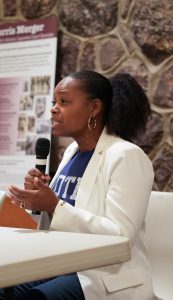 When asked where they saw direct connections to the merger today, both Brice and Kersey noted that fewer people seem willing to engage in the kind of sustained community action that made the merger possible. Kelley captured the sentiment:
“What was so wonderful about the merger was just the tenacity of the people who were for it, who were convinced that it had to happen, and the work they did to make it happen. I feel an aching in my bones for that kind of community.”
Kersey added, “When you have roots in the community, you know how to speak to the community. That’s how the Morris merger happened.” Kelley responded, “Now our community is who we see on our phones.”
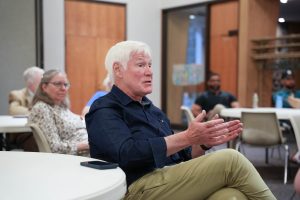 Community members also contributed their own memories and reflections. Virginia Lyttle, a member of Morristown UMC and a teacher in the Morris school district during the merger, recalled that students adapted well to the changes; it was the parents who struggled and argued.
Some attendees came to remember, to hear once again stories of community action and resilience. Others came to learn. Administrators from a nearby school district who are exploring integration attended in hopes of learning from the Morris merger. In that way, the merger finally had an opportunity to serve as a lighthouse, guiding others further along the path toward racial justice. “These opportunities invite us to hear stories that shape us, challenge us, and encourage us to become a more faithful and courageous community.” Rev. Cook Scott reflected.
The stories we tell shape us. The story of the Morris merger is not simply a chapter in local history; it is a reminder of what ordinary people can accomplish when they refuse to accept division as inevitable. More than fifty years later, the questions raised by the merger remain unresolved, but so does its promise. As new generations hear these stories and carry them forward, the lighthouse continues to shine, calling communities toward the difficult but necessary work of creating justice, belonging, and shared flourishing.