

Ahead of Easter each year, Rev. Marilyn Schneider, EPA’s Prison Ministries Coordinator asks Rev. Carmelo Urena, the Head Chaplain of the Philadelphia Department of Prisons (PDP), what he needs most. Each year since 2022, except for one year when toiletries were most urgently needed, the answer to that question has been “underwear.”
People who are incarcerated receive just one pair of briefs, and no undershirts or socks when they arrive at one of the prison system’s five facilities. To live without such necessities can be a dehumanizing experience. The Undies for Easter Campaign not only meets a practical need but also serves as an expression of God’s love and of our Christian belief in the human worth of those who are incarcerated.
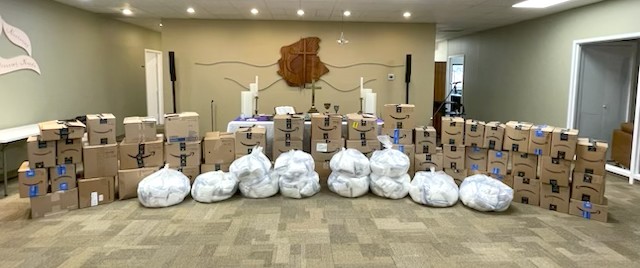
 With this year’s Undies for Easter campaign, United Methodists from across Eastern Pennsylvania and Greater New Jersey exceeded our initial goal and purchased over 2000 briefs, over 2000 t-shirts, and over 2000 pairs of socks for incarcerated individuals. Thank you for your incredible generosity! It makes a real and important difference in the lives of people in prison.
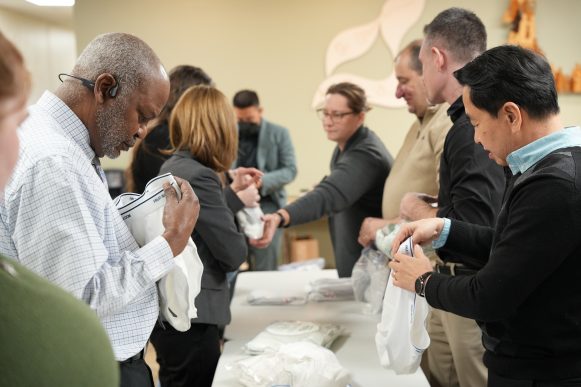
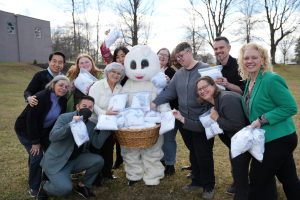 On March 25, EPA&GNJ staff on site at the Eastern Pennsylvania conference office assembled your donations into packages, each containing two pairs of briefs, two t-shirts, and two pairs of socks. The Easter bunny even ‘hopped’ by to say hello, creating a fun atmosphere as staff worked to fill Ziploc bags with the much-needed garments.
Then on Mar. 31, under the direction of Chaplain Urena, a group of eight members of EPA&GNJ dropped the donations off at Curran-Fromhold Correctional Facility, the largest facility in the PDP.
This year, I had the opportunity to be among those who hand-delivered the undergarments alongside my colleagues Bishop Cynthia Moore-Koikoi, Rev. Sean Lee, Assistant to the Bishop, District Superintendents Revs. Eunice Vega-Perez and Ronell Howard, Disaster Recovery Director Denise Shelton and her son Rawley, and Prison Ministries Coordinator Rev. Marilyn Schneider.
Shelton shared with me, “Since this program first began, my family has donated annually, but my thoughts have not gone much beyond recognizing that this is meeting a need of simple human dignity.” Her words named something true for me as well. I hadn’t given much thought to the realities of those who are incarcerated either.
The prison system, by design, creates distance between those incarcerated and everyday life in the broader community. Being part of this year’s delivery team allowed me to cross that distance, however briefly.
In the weeks leading up to the drop-off, my colleagues and I received detailed instructions about how to carry ourselves at the prison – everything from attire and rules about personal belongings to more sobering cautions like: Do not socialize, exchange pleasantries or conduct business with inmates in traffic areas. Do not engage in affectionate contact with inmates. Personnel may search your person, vehicle, or personal belongings at any time.
These warnings, however necessary, signaled that the space we would be entering was different from the outside world. We were going somewhere unpredictable, perhaps even dangerous, a place where a sharp line existed between those incarcerated and outsiders.
When I arrived at Curran-Fromhold Correctional Facility on drop-off day, my colleagues and I met in the main parking lot with Chaplain Urena—a tall, broad man with a calm demeanor and kind smile. As directed, we left our personal belongings in our vehicles and carpooled to the facility’s entrance, bringing only our driver’s licenses with us.
Without my purse or my phone, I felt out of place, even naked. How much more disorienting must it feel, I thought, for those who arrive to be incarcerated—stripped of personal effects not just for a couple hours, but for weeks, months, or years.
On the way over, I asked Chaplain Urena how long he had been serving as a chaplain in the prison system. “Seventeen years!” he exclaimed, adding “and before that I was in [prison] a couple of years. But I found God, and left that life behind, thanks be to God.” In just these few words, Chaplain Urena quietly disrupted the categories of incarcerated and outsider that had seemed so fixed. His passing testimony reminded me that God’s grace cannot be confined by categories of human creation.
When we arrived and entered the prison, we traded in our driver’s licenses for guest badges, then went through security. Each person was patted down to ensure we weren’t bringing any weapons or contraband into the prison. As we made our way to Building B, we passed through a series of locked doors, each one limiting access and reinforcing how restricted movement was within the facility.
When we walked by a space that looked like a small gymnasium, Rev. Schneider leaned over and explained that all those incarcerated were required to have access to an outdoor area—and this was it. From what I could tell, it was a bare concrete room, with the upper portion of the walls replaced by open-air fencing to let in light and air.
When we arrived at the pods where we would be delivering the undergarments, I was struck by how quiet it was and how empty it felt.
In one of the two pods we visited, a TV blared from somewhere out of sight, but otherwise the space was still. We stood on a platform that opened onto an empty common eating area. Doors lined the ground level, and a set of stairs led to an upper tier where more doors surrounded the space. These were the prison cells.
We set up two tables – one for handing out medium-sized garments and the other for handing out for large-sized garments. Bishop Moore-Koikoi explained that we give each person the size they request. Their choice, not what we thought they needed, would determine what they received. Even though this meant we would eventually run out of the large-sized undergarments that most of those incarcerated requested, respecting their choice was one small way we could affirm their dignity as human beings.
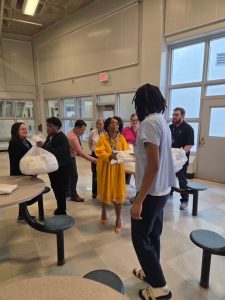 Shortly, guards began to open the cell doors one at a time, slowly allowing the incarcerated men to file past the tables where we were distributing the undergarments. Many expressed how appreciative they were and how much they needed the items given. Many said a simple thank you. Still others quietly smiled or met our eyes with a grateful glance. “In that moment,” DS Howard later reflected, “I heard the words of Jesus, ‘I was in prison and you visited me,’… What seemed simple became sacred.”
The warnings we were given led me to expect coldness, instead I encountered genuine kindness and care. Denise Shelton reflected:
I saw people helping people—not us, those who were incarcerated were helping each other. Several were debilitated in some way, even some in wheelchairs, using walkers or canes. Others who were more able bodied were helping them to get around or get items they needed.
Noting that one man did not need the socks from his packet, Shelton observed that he gave them to another. “He simply gave them as we did, without any conditions, simply showing the love of Jesus in the act of giving.”
As we moved from the first pod to the second, Chaplain Urena shared with us that sometimes Building B, the one we were visiting, was called the “forgotten block” because the people in it were known to act up.
On that day we did what Chaplain Urena and others like him do every day, we showed people who are incarcerated that we don’t forget them. And more importantly, God does not forget them.
DS Vega-Perez shared that she sensed God’s presence as she watched Chaplain Urena’s care for those incarcerated. She recounted, “He shared words that exemplified that care when he said, ‘I care deeply for these men, when I come to see them, I make sure I listen attentively to them. I even cry with them sometimes.’” Often the clearest way we can show God’s love is by simply recognizing another’s humanity and meeting it with our own.
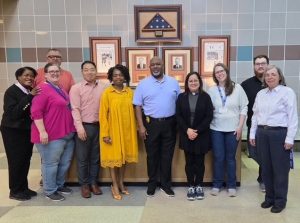 When we had finished delivering the undergarments – just a portion of those that will be shared through the Undies for Easter campaign – we made our way back to the facility’s lobby. There, we turned in our guest badges and were handed back our driver’s licenses, a simple exchange that marked our return to the outside world and our freedom to move about it.
We walked outside into the shining sun and open air, and Rev. Schneider offered a prayer of thanksgiving – for our time that day, for the donations purchased by so many, for the correctional facility staff and for all those within its walls.
We carpooled back to the main parking lot, got into our own vehicles, and each went on with the rest of the day. But the experience stayed with me—both the very real ways our world separates us, and the equally real ways we can reach across those divides. Prisons, by design, create distance. And the categories we create—incarcerated and free, insider and outsider—though sometimes necessary, are often harmful. But they are not the whole story.
When we choose to honor one another’s humanity—through something as simple as providing clean clothing, offering a smile, or showing up—we push against those boundaries. In doing so, we reflect the love of Christ, who crossed far greater divides to draw us close. There is still much work to be done, in addressing the root causes of crime, in responding to it, and in the criminal justice system. But efforts like Undies for Easter matter. Small acts of dignity and care matter. Treating people like people matters—more than we often realize.