


The 3rd Annual Stewardship & Generosity Summit on April 21, 2026, at Haddonfield UMC will feature Dr. Stephen Trzeciak as the keynote speaker. Dr. Trzeciak is a physician-scientist, Chief of Medicine at Cooper University Health Care, and co-author of the bestselling book Wonder Drug.
I recently had the opportunity to sit down with him to discuss his work. The following is an edited and condensed version of our conversation.
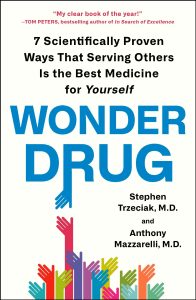 Emily Wilton: In Wonder Drug, you make the case that serving others is the best medicine for what ails us. That is a remarkable claim coming from someone with your experience and in your profession as a researcher and doctor. Could you summarize why you make that claim?
Dr Trzeciak: Do you think it’s a bold claim? It’s biblical!
Emily Wilton: It is biblical. I think it’s a bold claim coming from a doctor and not a pulpit.
Dr Trzeciak: So, here’s how I look at it. There are 250 original science research papers cited in our book. Those researchers did not create the truth. They did experiments which shined light on the truth, but the truth has been true from the very beginning.
So, for someone my age or younger who’s only known Me Culture it does seem like a bold claim. But if you have a biblical worldview, it’s not only not a bold claim, it’s like, well, duh…The book was written to take super complicated statistics and translate it for folks that don’t typically read that kind of stuff. It’s a secular science book. The research that we’ve synthesized could be in a TED talk kind of forum and that’s often where I’m invited to speak but that’s not who I am.
Emily Wilton: Tell me about where it comes from for you, then.
Dr Trzeciak: I’m a specialist in intensive care medicine so if you become my patient, it’s because you need life-sustaining therapies in the ICU. I spent the first 15 years or so of my career studying resuscitation science. The work was meaningful to me, but I was doing it because I knew how, and because it was very accessible to me. But it wasn’t the most pressing problem of our time. I thought that I needed to pivot to the things that matter the most.
We pivoted to study compassion in the context of healthcare, asking, “Does compassion really matter?” – not as a provocative question, but as a scientific one. Is compassion just like the cherry on top of the sundae? Is compassion the art of medicine, but not the substance and the science of medicine?
We tested a hypothesis that compassion matters not just in meaningful ways, but also in measurable ways. And the evidence does, in fact, confirm that compassion moves the needle on things you can measure – physiological effects on patients, psychological effects, adherence to medications, patient’s self-care, or just the quality of care. But one of the most powerful beneficial effects is effects on the giver. And that is supported by a ton of evidence.
When I was in med school in the early 90s, I was taught not to care too much, because too much caring burns you out. Now there is actually bona fide research that does show an association between compassion and burnout, but it’s inverse.
Instead of “high compassion, high burnout; low compassion, low burnout,” it was “high compassion, low burnout; low compassion, high burnout.”
The reason why it was relevant for me—and this is sort of where the science meets the personal—is because I became keenly aware that I had every symptom of burnout myself. Every single one.
And so, what was I supposed to do? The conventional thinking is take more vacations, go on nature hikes, put on your headphones and block out the world with your meditation app or whatever. There’s nothing wrong with any of those things, but I wasn’t buying it because to me, all those things are escapism.
So, I decided I was going to do an experiment on myself. I was going to care more, not less, lean in rather than detach, pull back, and escape. I got the deeper relationships that flowed from that. And that was when the fog of burnout began to lift for me.
Why? What we’ve come to find, Dr. Maz [Mazzarelli] and I, is that the scientific research clearly points to this: The key to resilience is relationships.
And here’s why it’s the answer to your question: We write this book and we start to get messages from people far and wide saying, “I did this. I tested the compassion hypothesis for myself. I was totally burned out, and I got the exact same results.”
That led us to think, well, it can’t just be something specific to healthcare workers. There has to be a common thread. So Wonder Drug was a follow-on to our first book, Compassionomics, and it was written not for the medical community, but for everybody.
Emily Wilton: That is really interesting and it opens up so many more questions. You mentioned this connection between burnout and compassion. Many churches struggle with sustaining their ministries, both financially and in terms of finding the people who are able and willing to serve. How does your work speak to the concerns of burnout in the church?
Dr Trzeciak: I have been a witness to what you’re describing. My hypothesis is that the same people keep getting asked to do all the work because they do a good job, and they’re actually willing to do it. Then they just get kind of used up, you know?
What the preponderance of the evidence points to is that the relationships that flow from our generosity are really what buffer us and maintain resilience. We have to take good care of each other because that’s what holds our teams together. And that’s what we find in healthcare as well.
The return on investment, so to speak, for compassion in organizations like mine is that it’s our compassion for each other that holds our teams together, and that is how the organization is stronger, if that makes sense.
Emily Wilton: It does make sense. I appreciate that from a pastoral perspective. It’s not just the compassion for those who we’re serving in mission, but also our compassion for one another as a congregation.
Dr Trzeciak: Especially because people are really good at the poker face. The older I get, the more I realize it’s just unbelievable how much pain people carry around.
They could be in line for coffee before service with you and they look like any other day, but they’re doing all they can just to hold it together.
Emily Wilton: What does your work encourage us to do differently given that reality?
Dr Trzeciak: A couple of things. Number one is very rigorous research from the University of Toronto shows us that in everyday life, we have nine opportunities for empathy every day. Nine.
And the reason why that is so striking to me every time I think about it is, like, okay, it’s 3:30. How many did I already miss today? When you start thinking about your opportunities in that way, you keep your eyes open in a little different way.
The other one I call “know your power.” In the book, we tell this story. I was caring for this 55-year-old man, and he was dying of septic shock. I could tell he wasn’t going to make it through the night.
I had to tell his sister who was just a couple years younger. I thought we were finishing the talk but as I was about to conclude, she said, “You don’t remember me, do you?”
I was like, what? No one’s ever asked me that before. I’m an ICU doctor, right?
I said, “I’m sorry…”.
She said, “It’s fine. This place is so crazy busy, I wouldn’t expect you to remember me, but I need you to know something.”
She pointed at the ICU bed that was directly across the hall from where her brother now lay and she said, “Seven years ago, my mom was in that ICU bed right over there and she was dying, and there was nothing that could be done to save her. You were her doctor, and you had to tell me that. So, you and me, we’ve had this talk before.”
It takes my breath away still when I think about it. But what she said next is the important part:
She said, “Those nurses, they were like angels to me. They held me in those days when my mom was dying, and they let me know I wasn’t going to go through it alone, and I didn’t—because of them. My mom and I were so close. I think about losing her every day and it hurts. But every time I think about losing her, I think about those nurses.”
She said, “It makes me feel better, even now.”
Seven years later. It wasn’t just that she remembered it, it was therapeutic for her. So, we call it “know your power,” because when you meet somebody at the end of their rope and you meet them with compassion, you may not even know what you just did, but they may literally never forget it the rest of their life. It echoes and reverberates and goes on and on, never to be forgotten, perhaps because there’s so much emotion associated with it.
The reason why I mention that is because when you know your power, when you know that those things happen, you look at your opportunities differently.
Emily Wilton: And you could argue that those are the lenses that Christ asks us to wear as we encounter people in the world.
Dr Trzeciak: For sure.
Emily Wilton: Thank you so much for your time. I really appreciate it.
Come to the 3rd Annual Stewardship & Generosity Summit where Dr. Trzeciak will connect his research to Scripture, faith, and the power of “Live to Give.” Register here.
To learn more about Dr. Trzeciak and his book Wonder Drug, visit https://www.wonderdrugbook.com/.