

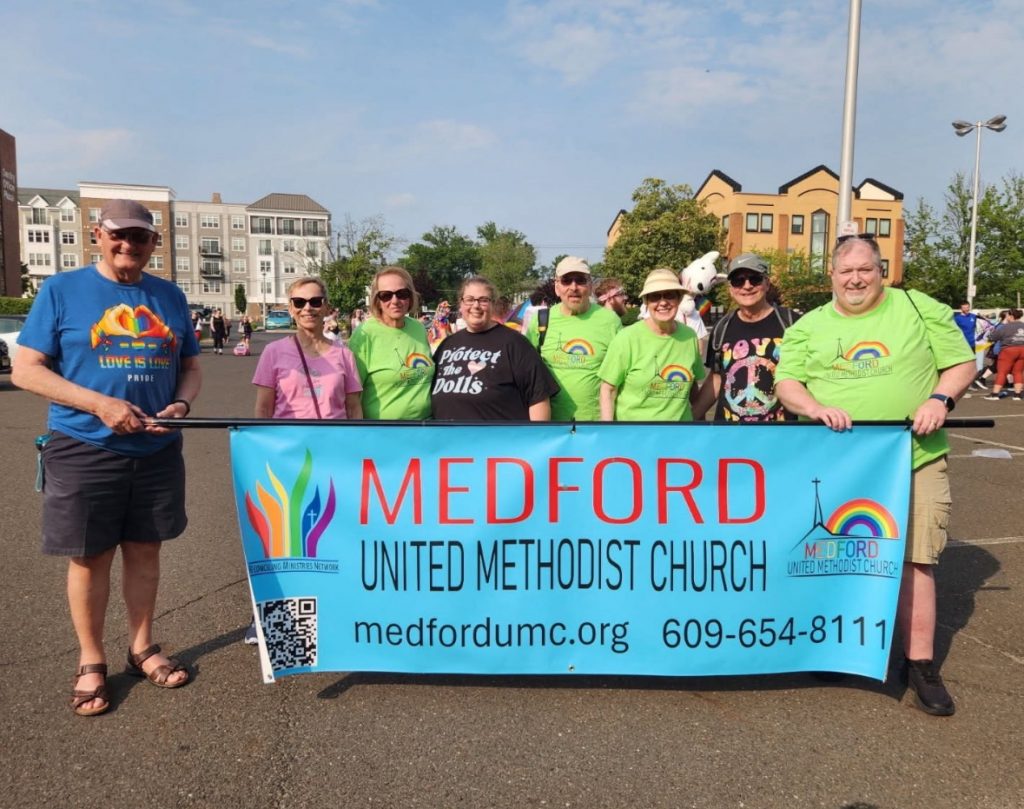
In a world where symbols can speak volumes about what one stands for, it isn’t surprising that a faith community would tread with caution when it comes to displaying a sign that might be perceived as divisive or controversial. Signs send a message—but what is that message? And how will people respond to it, especially if they disagree?
For Medford United Methodist Church, displaying the rainbow flag and the message, “All are welcome” is one important way of telling the community of Medford – and especially LGBTQ+ individuals within it – who the church is and who it is trying to be.
In January of 2020, the congregation took a vote to become a Reconciling Congregation – to not only welcome LGBTQ+ people in worship but also to include and affirm them at all levels of church participation and leadership. The vote passed with 86% of the congregation in favor.
Just two months later, the COVID-19 pandemic brought life as we knew it to a screeching halt. Church communities everywhere – Medford UMC included – had to shift their focus to new ways of doing church and ministry amid widespread illness. But in March 2022, the Reconciling Ministries Committee at the church was ready to get back in action. “The first thing we need to do is make sure that we live out what we said, as far as being reconciling. People need to know and understand what we’re doing and that we are inclusive and affirming,” shares George Ballinger who co-chairs the committee alongside Barbara Jensen.
The church placed several yard signs around their campus bearing the progress pride flag and the simple message, “We stand together.” A larger banner with a rainbow flag and the words, “All are welcome” was also hung near the church’s main sign. It has since been replaced with a more permanent sign with the same language.
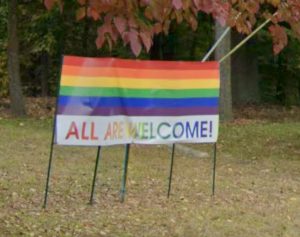
Even though the church had overwhelmingly voted in favor of becoming a Reconciling Congregation, some still had concerns about such a prominent visual display. Rev. Joe Monahan, Medford UMC’s pastor, shares that some congregants questioned why the church needed to focus so much on this one aspect of its identity. His answer? “It’s because when somebody rides by a church the default position or the default assumption is, ‘I am not welcome,’ so you have to over-communicate a message of welcome.”
Other congregants, Rev. Monahan explained, worried that the signage might make the church a target of hostility. Unfortunately, those concerns were not entirely unfounded. In the years since putting up the signs, Medford UMC has occasionally received pushback from individuals who do not agree with their messaging. Every now and again, yard signs will go missing or someone will leave a negative Google review on the church’s page. Some drivers-by have even used a bullhorn to amplify their discontent.
Yet what is more remarkable – and consistent – than these negative responses to Medford’s signage is the positive and fruitful impact of the church’s declared inclusivity. “We continue to deal with things like that from time to time, right up to this day. But the reality is that the number of people who visit because they see the signs vastly, vastly outweighs any of that,” says Rev. Monahan. “When you ask at new members classes over the past couple of years, to a person, they’ll name these flags as the reason why they’re there. That’s just real.”
Ballinger and Laura Beverage, another member of the Reconciling Ministries Committee, both lift up the story of a young man whose mother passed the church on her drive to work. She saw the signs and told her son, who is gay, that he should check out the church. He visited and has since become a vital member of the community, serving as a head usher, greeter, and serving Communion.
Several couples and young families have also visited the church and become members. “Some have come with their kids and I’ve seen the kids march off to Sunday School too, which makes me feel really good,” shares Melissa Maver, another Reconciling Ministries Committee member. Personally, she is grateful that her own son and his boyfriend can be comfortable visiting the church when they happen to be in town. “[These young families] want their children to be raised with the values of inclusivity and being warm and welcoming and affirming of all,” adds Beverage whose own daughter and daughter-in-law are raising four beautiful children together.
While Medford UMC’s signs have attracted many visitors, putting up a rainbow flag is, of course, not a standalone strategy for getting people to walk through the doors of your church. Monahan names the important truth that, “you can’t do this if that’s not your identity and if people aren’t going to get an authentic welcome.”
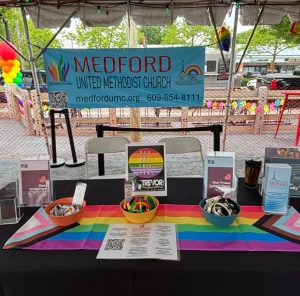 At Medford UMC, being a Reconciling Congregation runs much deeper than outward displays of welcome and inclusiveness. The church brings in speakers on different topics, like how to respect people’s identities by using their pronouns, and creates space for LGBTQ+ people to share their stories of faith. The Reconciling Ministries Committee leads church members in participation at Pride events. Some attend local meetings of PFLAG (an LGBTQ+ and ally advocacy organization) to show the church’s support and have joined local ally groups on Facebook.
In all these spaces, Medford UMC members are making connections, building relationships, and sharing the love of God. Ballinger says, regarding an upcoming Pride event, “We’ll be there telling people that God’s love is for all and those people that have been hurt by the church – and there are a lot of them – that it shouldn’t be that way and it doesn’t have to be that way.”
Through this intentional work, Medford UMC is becoming a beacon of hope for the LGBTQ+ community in Medford, a town where LGBTQ+ acceptance is not the norm. The church regularly hears from people – on the phone, via social media, and in person – who appreciate the message of love and support, who never imagined a church could be a place that fully affirmed them for who they are.
Some of these people may never come to the church, acknowledges Rev. Monahan, but “even if they can’t bring themselves to come to church, it’s an investment in goodwill.” He tells the story, for instance, of a playwright who saw the church’s signs and reached out about doing a reading of one of his plays in their hall. The play featured themes of welcome and inclusion and the playwright knew it would not be well received in the spaces he would normally perform. This is just one example of the many connections made possible by Medford UMC’s intentional work to become an affirming community. Their signs are one key way they communicate that with others.
While there have been moments of discomfort and pushback, Medford UMC’s journey as a Reconciling Congregation has been one of blessing. When signs disappear, they are replaced. Negative reviews are drowned out by grateful ones. And bullhorns can scarcely be heard over the sounds of praise for God’s all-encompassing love.
Medford UMC’s witness offers encouragement to congregations that embrace LGBTQ+ people and are discerning how, or whether, to make that welcome visible. As Rev. Monahan reflects, “If you’re wrestling with, ‘Is this going to hurt us?’ the answer is no, it’s not. It’s going to open up opportunities for people who might not have considered the church before to consider your church.”
In choosing to live out their promise of welcome boldly and visibly, Medford UMC has discovered a simple but powerful truth: signs matter—but the love they point to matters most.