

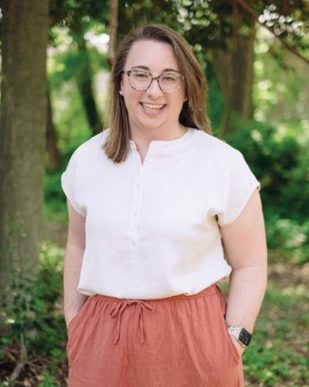
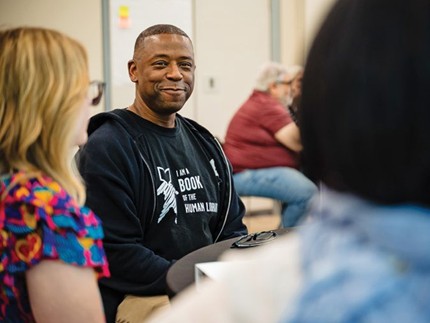
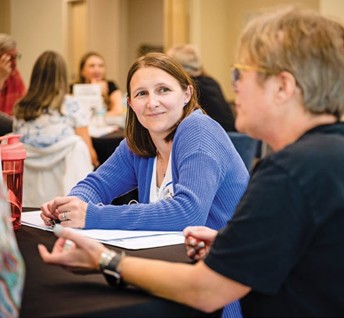
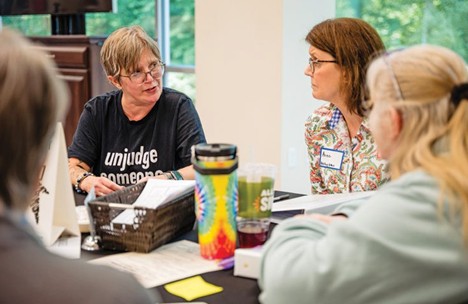
Pathway Bridges, a Lilly grant-funded program, has been equipping churches to bridge the gap between the church and the community since 2022. New cohorts launched in the spring and fall of 2025. Three years in, there’s still an aura of mystery around this amazing program, so I sat down with Alyssa Ruch, Director of Pathway Bridges, to learn more about the ins and outs of the program and what church leaders can expect from this experience.
This interview has been edited and condensed.
If you were to capture the essence of Pathways Bridges in a couple of sentences what would you say?
Bridges is cultivating curiosity about our space, our place, and our neighbors—particularly across lines of difference—in ways that allow us to foster empathy and truly see the perspective of the other.
How have you seen church ministries impacted by the Bridges program?
One of the beautiful things about Bridges is that it’s open for all churches to find their own space. We don’t have a cookie-cutter model that we expect churches to fit into in order to engage with us.
The churches we’ve worked with have really flourished and taken the program in directions that support their local communities. For example:
- Trinity UMC in Hackettstown launched a safe parking ministry for unhoused neighbors, born out of their work listening to the stories of people in their community.
- Haddonfield UMC recently hosted a neurodiversity summit and has made significant strides in their ministry with the neurodivergent community.
- Moorestown UMC developed an annual health fair after learning that many in their community weren’t aware of local resources. Each year, they showcase available services and invite the community to connect.
- Other churches, like Frenchtown UMC, have adapted longstanding dinner churches and breathed new life into them to incorporate storytelling and building new relationships with their neighbors.
What does participation look like for the local church? What’s the commitment?
At a minimum, it’s a twelve-month commitment, with optional group coaching for six months to support creative problem-solving. If you’re running into snags, it’s a great way to crowdsource wisdom and think things through together. One of the exciting innovations is that coaches are now in-house and visiting local contexts.
Walk us through that change.
Previously, we relied heavily on external coaches, support staff, and presenters. In this iteration, we’re intentionally lifting up and celebrating the gifts within our two annual conferences. There are people right here who are thriving in ministry, and we want to learn from one another.
One major challenge we heard before was that while external coaches were knowledgeable in ministry areas, they didn’t really understand the specific contexts churches were coming from.
As we envisioned this new season of Bridges, it was really important to me to find ways to show up for local churches—to worship with them, learn about their community, and be physically present.
That’s one of the real gifts of in-house coaching: we now have the ability to go, to be present, and to learn firsthand so we can better walk alongside churches as they engage in this work.
Is there anything else you’d like to share about the Bridges program?
Bridges is different from many other conference programs. It’s an opportunity to learn in community—with pastors and laity—something that rarely happens outside of annual conference.
We intentionally structure the schedule, so that there is space to process and practice the tools. It’s not just that we are dumping a lot of information and leaving you to figure out later whether this may or may not help you. Rather, we’ll work on tools and then hold space for you to try those and to think through how that fits with your congregation before going deeper and doing more work.
It’s an intentional journey—an opportunity to support and pour into church leaders. It’s transformational.
Through Bridges we celebrate permission to try some thing new, even if it fails. We celebrate failure because where we are going, we haven’t been yet. And so, it takes courage to step beyond our comfort zones of how we’ve always done ministry and begin to meet people where they are.
If someone were to join Bridges right now, what would their commitment look like?
We start with Hospitality. These sessions are currently held virtually, which reduces the need for pas-tors and laity to travel or give up a Saturday.
Then there are two in-person sessions where a team consisting of the pastor and laity attend together. Since this is a cross-conference initiative, we hold sessions in both annual conferences. We’re very intentional about location—we consider where cohort churches are based and make sure no one has to travel an unreasonable distance.
The session on community engagement happens at the local church, which is great because it builds greater buy-in from the congregation.
The last thing we have is a pastors’ retreat—a time to pour into the pastors, spark their imagination, and prepare them to think creatively.
If someone wanted to connect with Bridges, how could they do that?
We have a new website—it ’s really cool: PathwayBridges.org. You can contact us through the site.
We also have a great resource library that I’m a huge fan of.
One of our core values is that, while we’ve been doing this work for a long time, we don’t claim to be the experts. There’s a lot of wisdom in the room, and we don’t want to be the sole keepers of that knowledge. That’s why we’ve been intentionally building a public resource library for anyone who visits the site. You can explore the books, podcasts, websites, and other tools we’re using as we develop this work.
Thank you Alyssa. My pleasure.
If you are looking to connect more deeply with the community outside the doors of your church, this program is for you. Take the first step in a journey towards deeper connection with your neighbors, visit pathwaybridges.org today.