

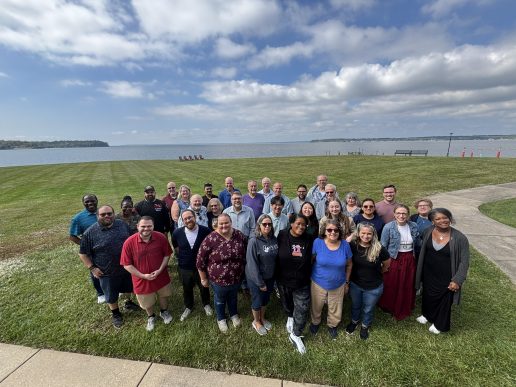
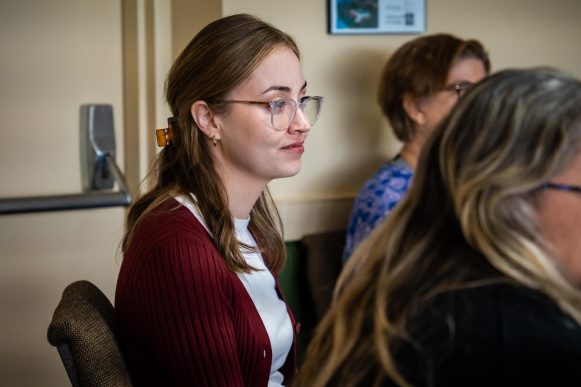
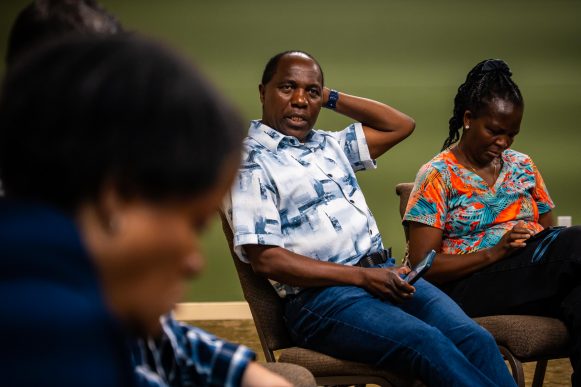
In a season when spiritual life is often under fire, clergy from across the Greater New Jersey Conference gathered at Sandy Cove Ministries for the 2025 Coastal Plains Regional Clergy Retreat. Ministry today brings more than the usual challenges. Disaffiliations, shrinking resources, cultural suspicion of institutions, and the personal toll of long years of leadership have left many pastors weary and stretched thin. Into that climate, the retreat offered a spacious pause—a time to rest, to be honest about the strain, and to remember that God’s Spirit still moves even when faith feels fragile.
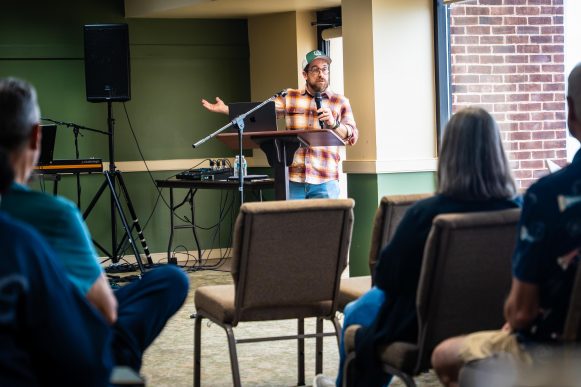
The retreat was facilitated by the leadership of Rev. Mike Baughman, a fourth-generation United Methodist minister and New Jersey native who now serves in Dallas as Vice President of Social Impact at Bonton Farms. His presence was more than biographical interest: his ministry in a community shaped by redlining and concentrated poverty provided a living metaphor for what it means to nurture life under difficult conditions. Just as identical seeds planted in different soil yield different results, he reminded participants, so too do the conditions of ministry shape what can grow. When spiritual life is under fire, it is not because the seed is defective but because the soil is hostile. God’s call, then, is to tend the soil, plant faithfully, and trust that growth can come in places that seem barren.
Across lectures and small group conversations, Baughman returned to images of planting and harvest, pairing them with the realities of fear and grief that so often stalk the pastoral life. Fear, he said, is not an enemy to be banished but a place where God’s presence is made known. Scripture’s most repeated word from the angels—“Be not afraid”—does not deny fear but assumes it. “Blessed are you, fearful one,” he said, “for God is present in the presence of fear.” For pastors carrying the weight of anxious congregations and uncertain futures, this was a liberating word: even when our spiritual lives are under fire, God is near in the trembling.
Grief, too, was treated not as something to escape but as a teacher. Baughman personified grief as a companion whose approach is often dreaded and whose departure is noticed only after the fact. Through story and reflection, he invited clergy to recognize grief as part of the call, not a distraction from it. Just as the disciples entered Jerusalem expecting glory and power but found disappointment and death instead, ministry too often confronts leaders with outcomes far from what was imagined. Yet even there, God works. Western Christianity’s fixation on light and victory, Baughman warned, can blind us to the reality that much of God’s most transformative work happens in the dark: creation, Passover, resurrection. To follow Christ is to accept that when life is under fire, divine presence is not extinguished but revealed in new depth.
The retreat was not all theory. Baughman’s stories from church planting and social enterprise grounded theology in lived experience. He described “mischief gardening,” scattering sunflower seeds in unexpected places just to see what might grow. The practice delighted him not only for the plants it produced but for the surprise and joy it sparked in others. Ministry, he suggested, might be just as mischievous: when the usual programs falter, pastors can still plant small, playful seeds—of hope, of service, of community—that sprout in ways no one predicts. In times when clergy feel burned out, this reminder that God can use even the smallest, most subversive acts to bring life offers a path forward.
Companion planting became another powerful metaphor. Just as tomatoes need beans to enrich the soil, marigolds to fend off pests, or sunflowers to provide support, pastors thrive when they invite others to complement their gifts rather than trying to do it all themselves. “Do not deny the church your best giftedness,” Baughman said, “and do not deny others the chance to bring theirs.” When spiritual life is under fire, it is tempting to retreat into isolation or over-functioning, but the Body of Christ flourishes when each member brings what they have and allows others to fill the gaps.
Again and again, the retreat returned to the reality that the conditions of ministry today are hard. The statistics are sobering: only 49% of United Methodist clergy feel effective in their work, compared with more than 85% in higher education and 90% in the corporate world. Nearly one-third report symptoms of depression that impair daily functioning, almost triple the national average. Many feel isolated and misunderstood even by family and friends. These trends have not improved over the last decade. It is no wonder that many clergy feel their spiritual lives are under fire.
But the retreat refused to let that be the final word. The rhythms of prayer, silence, play, and song created room for clergy to lay down burdens and be ministered to themselves. Breakout conversations fostered new relationships across the region, reminding pastors that they are not alone. Communion at the close of the retreat underscored the truth that in Christ’s body, every part is needed, and that the table is open to all who take even one step toward grace. The bread and cup, made from seeds planted, harvested, crushed, and transformed, became a living witness that God is still sowing new life in and through weary leaders.
What clergy carried home from Sandy Cove was not a ten-year plan but, in Baughman’s words, the commitment to discern “the next most faithful step.” The retreat’s flow—Reclaim, Regroup, Re-engage—gave shape to that calling. We reclaimed our sense of vocation by facing fear and grief with honesty. We regrouped by companion planting with colleagues, drawing strength from one another’s gifts. We reengaged our calls with renewed imagination for authentic, community-rooted ministry.
In a season when spiritual life is often under fire, this retreat reminded us that God’s Spirit is still at work in the dark, still planting seeds of hope, and still calling the church to courage, creativity, and compassion.