

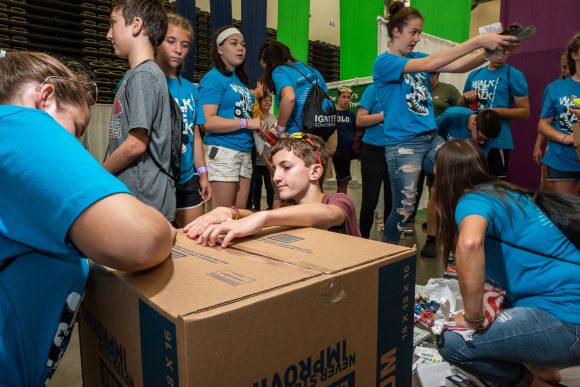

Twenty years ago, when the United Methodist Churches in Camden formed Camden Urban Ministry Initiative (CUMI) to reach neighborhood youth and young adults, no one would imagine that spending a weekend in Wildwood would ignite their ministry and change the lives of the youth in Camden. Now the leaders can’t imagine not including IGNITE in their ministry to show young people the transforming power of Christ’s love.
CUMI brings together a group of small churches who are dedicated to helping the youth of their city and know that they can do more through their connection. CUMI works to actively influence youth to choose a better path, resulting in caring, successful adults that stay involved and better the community of Camden.
Each year, this formidable force of five churches–Asbury UMC, Bethel UMC, Ferry Avenue UMC, Parkside UMC and New Beginnings UMC—bring dozens of young people to IGNITE, giving those students the chance to connect with God and their peers in new and different ways.
“We’re all about the youth,” said co-founder Shirley Stewart who is also the assistant to Rev. Keith Dickens at Parkside UMC, an historian and a member of the Superintendency Committee of Gateway South.
She recalled how wonderful last year’s IGNITE event was when IGNITE’s mission project included collecting school supplies to be donated to CUMI. “It was amazing and so needed,” said Stewart.
Stewart considers IGNITE just one part of her ministry with the youth of Camden. Along with Waverly Singleton, who is the council chairperson at Parkside, Stewart organizes Camp CUMI for both the students and their parents. Camp CUMI provides back-to-school resources like uniforms, meals and gifts during the holidays as well as field trips to the Camden Aquarium, Camden’s Children Garden, Playdrome for bowling, African drum performance at King Church and Mann Music Center.
“We’ve watched them grow up and graduate high school. It’s quite an experience,” said Stewart who has been a Camden resident for 65 years after moving from Philadelphia when she was 10.
She added that fellowship and recruitment are also part of the program, adding that some students are reaching the homeless with “evangelism on the street.”
CUMI also offers a Skills-N-Drills Program that not only teaches children the fundamentals of basketball and the importance of being physically fit but also focuses on teaching children teamwork, leadership, responsibility and trust.
“There’s so little some of these kids get to experience. They miss out on a lot. Through CUMI, we get to bring some of that to them, and it’s an honor,” Stewart said.